
Fair Lending in Flux: How the 2025 Disparate-Impact Rollback Is Reshaping Compliance Risk
In 2025, one of the most consequential regulatory shifts for banks, lenders, and credit-service organizations came quietly but carried enormous implications: the rollback of “disparate-impact” supervision under federal fair-lending laws.
This change, led by the Office of the Comptroller of the Currency (OCC) in mid-2025 and echoed by the FDIC and other agencies, has fundamentally altered how compliance teams must think about risk, fairness, and regulatory exposure in lending.
What Changed
On July 14, 2025, the OCC issued Bulletin 2025-16, removing all references to “disparate impact” from its Fair Lending examination handbook.
The directive instructs examiners not to assess or request a bank’s disparate-impact analyses or related policies, effectively ending the federal government’s long-standing practice of evaluating whether a neutral policy might have a disproportionate effect on protected classes.
This decision aligns with Executive Order 14281, titled “Restoring Equality of Opportunity and Meritocracy,” which directs federal agencies to eliminate disparate-impact liability wherever possible.
As a result, the compliance lens on fair lending has shifted, and organizations are now facing a mix of opportunity, confusion, and new risk exposure.

Why This Matters
For years, fair-lending compliance programs have centered on managing both disparate treatment (intentional discrimination) and disparate impact (unintended but disproportionate effects).
The new guidance creates a vacuum, and with it, significant challenges:
Compliance Infrastructure Mismatch: Many institutions have invested heavily in monitoring, data analysis, and vendor models that evaluate disparate-impact risk. Now, those systems may be seen as unnecessary under federal review, or worse, may no longer align with evolving regulatory expectations.
Fragmented Oversight Environment: While federal agencies may pull back, state regulators and private plaintiffs remain free to pursue disparate-impact theories under state anti-discrimination laws. This inconsistency creates a patchwork of compliance obligations that vary by jurisdiction.
Legal Uncertainty and Model Risk: Lenders relying on automated decisioning tools, AI-driven underwriting, or third-party credit models now face tough decisions about whether to continue or scale back fairness testing. Removing federal oversight doesn’t eliminate legal risk; it simply shifts where that risk resides.
Documentation and Defensibility: Regulators may not be reviewing disparate-impact reports, but compliance teams must still demonstrate that lending decisions are based on legitimate business justifications. Strong documentation and consistent governance remain critical.
What You Should Do
Compliance and legal teams should view this not as a signal to de-emphasize fairness, but as a reminder to adapt their frameworks to a more fragmented oversight landscape:
Reassess Fair-Lending Policies and Training: Update internal procedures to reflect the new regulatory stance while maintaining a culture of equity and fairness.
Review State-Level Requirements: Some states are already signaling they’ll retain or strengthen disparate-impact standards.
Evaluate Vendor and Model Governance: Ensure third-party tools align with both new federal expectations and your institution’s risk tolerance.
Document Business Rationales: Maintain evidence that lending and underwriting decisions serve legitimate business objectives, even absent formal disparate-impact testing.
Stay Agile: Regulatory shifts can reverse quickly with future administrations. Staying prepared for a potential reinstatement of disparate-impact oversight is prudent.
Winnow Can Help
As lending laws evolve, staying current is no longer optional; it’s strategic.
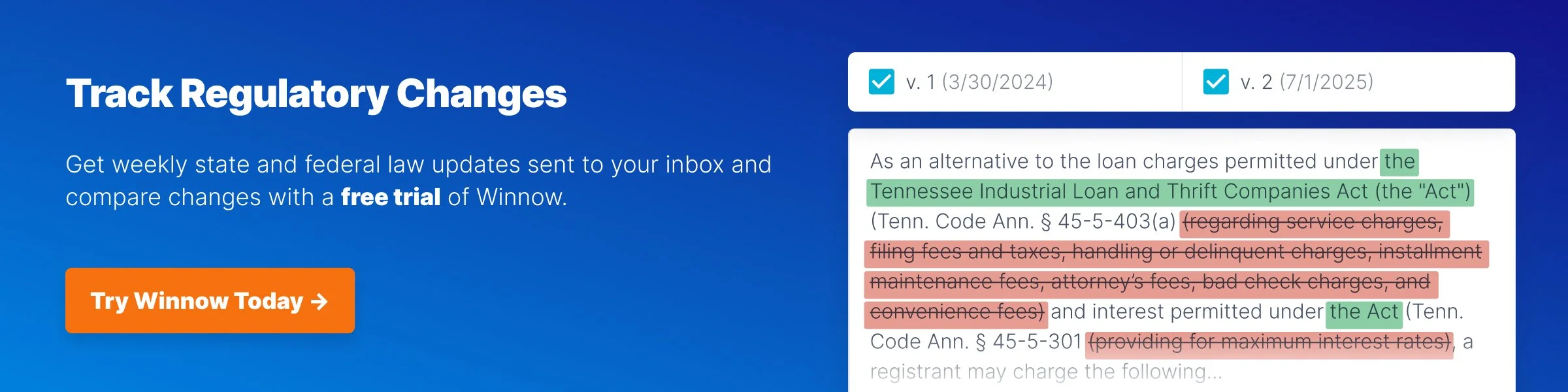
Winnow enables compliance, legal, and risk teams to monitor state and federal lending law changes in real time, compare requirements across jurisdictions, and adjust internal policies before they become liabilities.
Our intelligent compliance tools help your team:
Track new and amended regulations at both the state and federal levels.
Identify emerging areas of regulatory divergence.
Simplify how your organization interprets and applies complex rule changes.
With Winnow, your compliance and legal teams can shift from reacting to regulation to leading through it.
The Bottom Line
The 2025 rollback of disparate-impact supervision marks a pivotal change in how fair-lending risk is defined and managed.
For compliance leaders, it’s a moment that underscores the importance of agility, awareness, and technology-driven insight.
In an era of shifting expectations and growing state-level enforcement, staying ahead means staying informed, and Winnow helps you do exactly that.
Stay compliant. Stay confident. Stay ahead, with Winnow. Request a demo today