
Data Privacy & Consumer Consent: Why It’s Becoming a Top Compliance Priority for Lenders in 2025
In the lending industry, data is the fuel that drives marketing, underwriting, customer experience, and risk management. But as lenders collect and use more consumer information, regulators across the country are rapidly rewriting the rules, particularly regarding data privacy and consent.
In 2025, lenders face a growing patchwork of state privacy laws, new expectations around automated decisioning, and heightened scrutiny involving data sharing, cross-selling practices, and affiliate relationships. These changes are no longer simply “privacy issues”; they are increasingly being tied to lending compliance, fair lending, and UDAAP/UDAAP risk.
For legal and compliance teams, staying ahead of these privacy-related obligations has become both a competitive challenge and a regulatory necessity.
The Explosion of State Privacy Laws, and What They Mean for Lenders
California set the tone with the CCPA/CPRA, and other states quickly followed. As of 2025, privacy laws in Colorado, Connecticut, Virginia, Utah, Oregon, Texas, and other states impose new requirements on how lenders:
Collect personal data
Notify consumers
Obtain and track consent
Store and share information
Use data for automated decision-making
Segment or target consumers for marketing
For lenders operating across multiple states, including banks, credit unions, mortgage companies, auto finance groups, fintechs, and specialty finance providers, the challenge grows exponentially each year.
These laws differ significantly in:
Notice requirements
Opt-in/opt-out rules
Sensitive data definitions
Data minimization standards
Restrictions on selling or sharing data
Rules for profiling and algorithmic decision-making
The result: a new layer of regulatory fragmentation that must now be integrated into existing lending-compliance frameworks.

Consumer Consent Is Becoming a Core Compliance Issue, Not Just a Privacy One
Across these state statutes, consent management is emerging as the centerpiece of new expectations. Regulators increasingly want consumers to have clear, affirmative, informed choices when lenders:
Share information with affiliates or third-party vendors
Use data for cross-selling or remarketing
Apply automated decisioning tools or AI-driven scoring
Collect sensitive categories of information
Reuse data for purposes beyond the original transaction
For lending organizations using sophisticated marketing funnels, third-party data models, digital underwriting tools, or outsourced lead-generation partners, the implications are substantial.
Why this matters for lending compliance:
Missing or invalid consent is now being treated as a UDAP/UDAAP violation
Improper data use can lead to allegations of digital redlining or disparate impact
Third-party vendors are becoming compliance liabilities when consent controls are weak
Regulators expect auditable, trackable consent records across all systems, not just marketing platforms
Lenders must now treat consent with the same rigor historically applied to disclosures, adverse action notices, or licensing obligations.
Automated Decisioning Is Under New Scrutiny
AI and machine-learning underwriting tools are transforming lending, but they’ve also drawn the attention of state and federal regulators.
Privacy laws increasingly contain specific provisions addressing:
Profiling
Predictive analytics
Automated credit decisions
Targeted advertising using financial information
Some states require consumer opt-out rights related to automated decision-making. Others require explanations or enhanced disclosures when algorithms materially affect a lending outcome.
For compliance and general counsel teams, this means automated decisioning is no longer just a fair lending issue; it’s also a privacy and consent issue, regulated at the state level and enforced through UDAP-related frameworks.
Data Sharing with Affiliates and Vendors: A Growing Risk Area
Lenders rely on vast networks of service providers, CRM platforms, analytics vendors, lead generators, brokers, and technology partners. Many of these vendors access or process consumer data on behalf of the lender.
State privacy laws now require lenders to:
Track where data is sent
Maintain contracts defining data use limitations
Obtain consumer consent before sharing data in certain situations
Ensure downstream vendors comply with privacy and retention requirements
These obligations overlap with long-standing federal expectations around vendor oversight, creating yet another layer of compliance complexity.
Cross-Selling and Marketing Are No Longer “Low-Risk” Activities
Cross-selling has traditionally been seen as a revenue optimization activity. But evolving privacy laws and aggressive fair lending enforcement are reshaping the risk profile.
Lenders now face new expectations when using data to:
Send targeted offers
Pre-qualify customers
Segment audiences
Retarget website visitors
Market additional credit products
Privacy rules and UDAP/UDAAP standards are converging here. Consumer profiling done without proper consent or using data in a way consumers did not anticipate can trigger enforcement.
Why Data Privacy Matters More Than Ever in Lending Compliance
1. More data = more regulatory risk
Lenders handle some of the most sensitive financial data. The more integrated your data ecosystem becomes, the greater your exposure to privacy laws.
2. Privacy violations are increasingly framed as UDAAP
Regulators have begun treating unclear, missing, or misleading data-use disclosures as unfair or deceptive acts.
3. Fragmented state laws create operational complexity
Compliance teams must now track dozens of state privacy rules, each with different obligations, exemptions, and definitions.
4. AI/automation intensifies regulatory pressure
Automated decision-making without transparency or clear consumer choice is a major emerging risk area.
5. Vendor management and third-party oversight are under the microscope
Lenders must verify that every vendor touching consumer data meets privacy requirements, not just lending-related ones.
How Winnow Helps Lending Organizations Navigate Privacy & Consent Requirements
As privacy laws converge with lending compliance, teams need tools designed to keep pace with accelerating regulatory change.
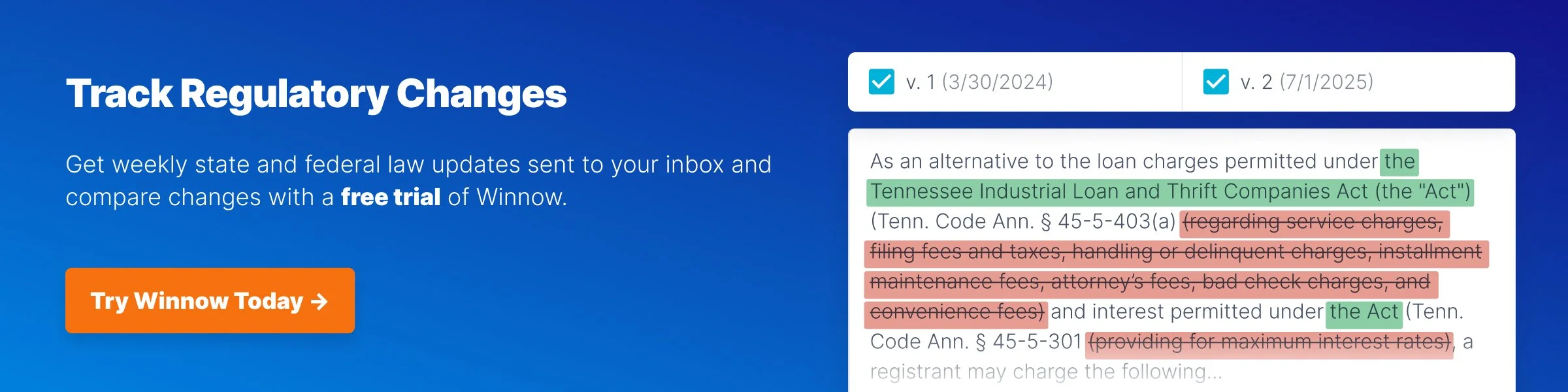
Winnow’s platform supports compliance leaders by:
Delivering near real-time updates across state and federal privacy requirements
Tracking newly effective, amended, and repealed laws
Reducing manual research efforts and oversight gaps
Providing guidance on a nationwide or state-by-state basis
Drastically reducing the costs associated with compliance research
Privacy obligations can shift weekly. Winnow ensures compliance teams don’t miss critical changes that directly affect lending operations.
Final Thoughts
Data privacy is no longer a background issue for the lending industry; it has become a front-line compliance priority. As more states enact laws each year and regulators increasingly link data practices to UDAAP and fair lending risk, legal and compliance leaders must be equipped with the right tools and information.
Organizations that modernize their compliance programs, particularly around consent management, automated decisioning, and data governance, will avoid unnecessary risk and gain a competitive advantage.
👉 See how Winnow can supercharge your compliance workflow. Request a demo today