
Regulatory Compliance in the Lending Industry: Top Q2 2026 Challenges for Banks, Credit Unions & Lenders
Regulatory compliance in the lending industry is intensifying in Q2 2026. Learn how banks, credit unions, mortgage lenders, and auto lenders can prepare for CFPB, FTC, and state enforcement trends.
TL;DR: What Lending Institutions Need to Know for Q2 2026
Federal enforcement is accelerating, particularly from the Consumer Financial Protection Bureau and Federal Trade Commission.
Cybersecurity, data privacy, fair lending, UDAAP, and AI-driven underwriting models are top enforcement priorities.
State-level regulatory divergence is creating a complex compliance patchwork for multi-state lenders.
AI and automated decision-making tools face heightened scrutiny for bias, transparency, and consumer impact.
Proactive regulatory impact assessments, model governance, and cross-functional compliance oversight are critical to mitigating risk in Q2 2026.
What’s Ahead for Regulatory Compliance in the Lending Industry in Q2 2026?
For banks, credit unions, mortgage lenders, auto lenders, fintech lenders, and the law firms advising them, Q2 2026 is shaping up to be a pivotal compliance quarter.
Regulators are shifting from issuing guidance to pursuing enforcement. Supervisory examinations are becoming more data-driven, and agencies are increasing scrutiny of internal controls, third-party risk management, consumer disclosures, and algorithmic underwriting systems.
Organizations that operate across multiple states face additional complexity due to diverging privacy laws, licensing rules, and consumer protection standards.
Below are the top regulatory compliance risks in the lending industry for Q2 2026, and how compliance officers and legal counsel can stay ahead.

Challenge #1
Intensified Federal Enforcement in Financial Services
The Consumer Financial Protection Bureau continues to prioritize:
UDAAP (Unfair, Deceptive, or Abusive Acts or Practices)
Fair lending and redlining investigations
Servicing compliance failures
Junk fee enforcement
AI-driven credit decision transparency
The Federal Trade Commission remains active in:
Data security enforcement
Consumer privacy practices
Marketing and lead-generation compliance
Fraud prevention and cybersecurity failures
For publicly traded financial institutions, the Securities and Exchange Commission is expected to maintain focus on:
Cybersecurity governance disclosures
Risk management transparency
Internal control failures
Why this matters for lenders:
Enforcement actions increasingly focus on documentation gaps, weak model governance, and inconsistent consumer disclosures. Examiners are requesting deeper audit trails and clearer evidence of board-level oversight.
Challenge #2
Fair Lending & AI Model Risk: A Major Exposure Area
Artificial intelligence and machine learning models are used in:
Credit underwriting
Pricing optimization
Fraud detection
Loan servicing automation is under heightened review.
Regulators are examining:
Disparate impact risks
Algorithmic bias
Training data governance
Explainability frameworks
Adverse action notice accuracy
Lenders deploying automated decision systems must implement:
Model validation protocols
Bias testing and monitoring
Documented model risk management frameworks
Clear escalation procedures
Failure to do so may lead to enforcement actions, supervisory findings, or exposure to civil litigation.
Challenge #3
State-Level Regulatory Divergence & Privacy Law Expansion
State regulators continue expanding privacy and data protection standards beyond federal baselines.
California enforcement under the California Privacy Rights Act is intensifying.
Virginia has introduced amendments to opt-out rights and consumer data access provisions.
Additional developments are emerging in Colorado and Connecticut.
For multi-state banks and nonbank lenders, this means:
Different disclosure obligations
Varying consumer opt-out mechanisms
Diverging data retention standards
Increased compliance documentation burdens
A single national compliance policy is no longer sufficient. Institutions must adopt adaptable, jurisdiction-specific compliance frameworks.

Challenge #4
Third-Party & Vendor Risk Management in Lending
Regulators are increasingly holding lenders accountable for the actions of:
Lead generators
Loan origination software providers
Data aggregators
Call centers
Marketing affiliates
Vendor risk management programs must now include:
Enhanced due diligence
Contractual compliance controls
Ongoing monitoring
Audit rights
Data handling transparency
Examiners expect to see evidence that boards and senior leadership maintain oversight of outsourced functions.
Challenge #5
Cybersecurity & Data Governance Enforcement
Data breaches, ransomware events, and consumer data misuse continue to drive enforcement activity. Key compliance expectations include:
Incident response planning
Data minimization practices
Encryption and access controls
Timely consumer notifications
Board-level reporting structures
Cybersecurity is no longer just an IT issue; it is a regulatory compliance priority for the entire organization.
How Lending Institutions Can Prepare for Q2 2026
To reduce enforcement exposure, compliance teams should:
Conduct a Regulatory Impact Assessment: Map new federal and state developments to internal policies, underwriting processes, and servicing operations.
Strengthen Fair Lending & Model Governance: Document AI oversight, bias testing, and explainability controls.
Update Vendor Risk Management Programs: Reassess third-party oversight and contract provisions.
Improve Documentation & Audit Trails: Ensure examination-ready records across consumer communications, risk decisions, and escalation processes.
Enhance Cross-Functional Collaboration: Align legal, compliance, risk, IT, underwriting, and executive leadership to ensure consistent governance.
In Conclusion:
Building a Resilient Compliance Strategy in 2026
Regulatory compliance in the lending industry is no longer reactive; it must be strategic, data-driven, and integrated across the enterprise.
Banks, credit unions, mortgage lenders, auto lenders, and their outside counsel must prepare for:
Intensified federal enforcement
Increased state-level complexity
AI and fair lending scrutiny
Expanded documentation expectations
Organizations that invest now in governance, model risk management, vendor oversight, and cross-functional compliance alignment will be better positioned to navigate Q2 2026 and beyond.
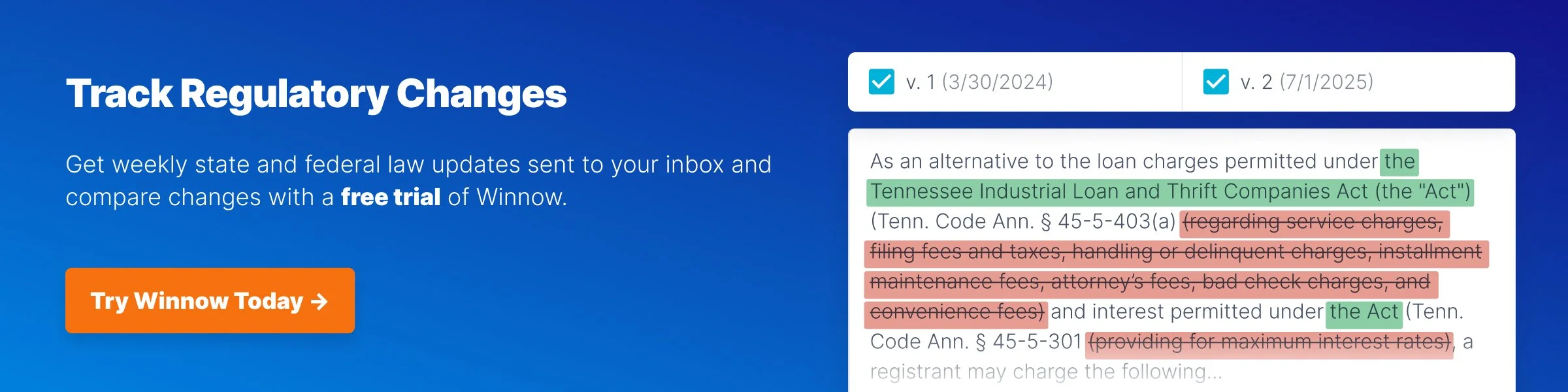
👉 Stay Ahead of Regulatory Risk. Try Winnow for Free »